FINITE ELEMENT STUDY ON ANGULATED ABUTMENTS IN MAXILLARY POSTERIOR DENTAL IMPLANTS
DOI:
https://doi.org/10.15294/jptm.v26i01.29582Keywords:
Abutment angulation, Dental implant, Finite element analysis, Posterior maxilla, Von Mises stressAbstract
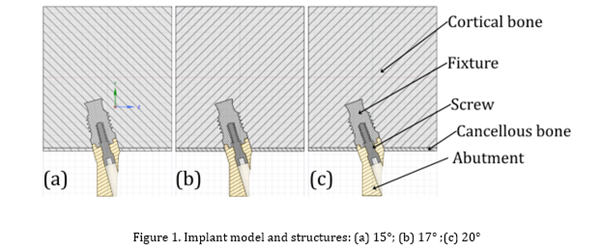
Dental implants in the posterior maxilla often require angulated abutments due to anatomical limitations. However, increased abutment angulation may influence stress distribution and compromise mechanical integrity. This study aimed to evaluate the biomechanical behavior of implant components with 15°, 17°, and 20° abutment angulations using three-dimensional finite element analysis (FEA). A static vertical load of 276 N was applied to a D4-type bone block model. Results showed that higher abutment angles led to increased von Mises stress and strain, particularly on the abutment U-profile and the screw head. Despite the rising stress, all configurations maintained safety factors above 1.5. These findings indicate that angled abutments up to 20° are mechanically safe under axial loading conditions, supporting their use in clinically challenging posterior maxillary regions.