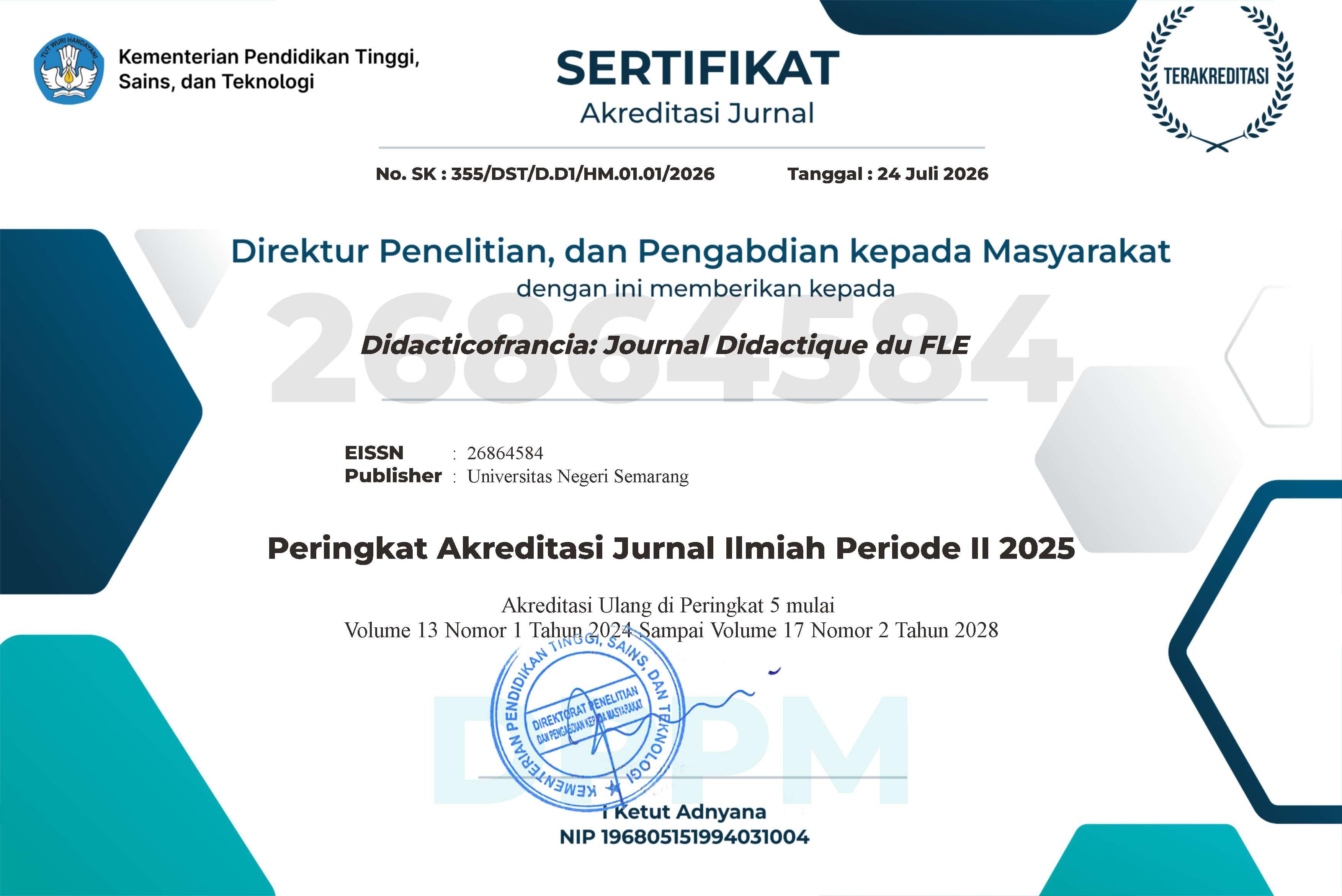
About the Journal
Focus and Scope
This journal aims to promote a principles-based approach to research on French language and literature by encouraging inquiry into the relationship between theoretical and practical studies. The journal welcomes contributions in the following areas of analysis:
- Didactics of French;
- Didactics of French literature;
- Evaluation in French Learning;
- French for Foreign Language;
- French for Specific Purposes;
- French/ Francophone literature;
- Translation & Interpretation;
- French linguistics;
- French language acquisition.
Peer Review Process
All manuscripts submitted to this journal must follow the focus and scope and author guidelines of this journal. The submitted manuscripts must address scientific merit or novelty appropriate to the focus and scope. All manuscripts must be free from plagiarized content. All authors are advised to use plagiarism detection software to do the similarity checking. Editors check the plagiarism detection of articles in this journal by using the Turnitin software.
The research article submitted to this journal will undergo single blind review. The reviewer provides valuable scientific comments that improve the manuscript's content.
The final decision of article acceptance will be made by the Editors according to reviewer comments. Publication of accepted articles, including the sequence of published articles, will be made by the Editor in Chief by considering the sequence of accepted dates and geographical distribution of authors, as well as the thematic issue.
Open Access Policy
This journal provides immediate open access to its content on the principle that making research freely available to the public supports a greater global exchange of knowledge.
This journal is open open-access journal, which means that all content is freely available without charge to users or / institutions. Users are allowed to read, download, copy, distribute, print, search, or link to full-text articles in this journal without asking prior permission from the publisher or author. This is by the Budapest Open Access Initiative.
Publication Ethics
Our Publication Ethics are based on COPE's Best Practice Guidelines for Journal Editors.
Duties of Authors
Reporting Standards: Authors should present an accurate account of the original research performed as well as an objective discussion of its significance. Researchers should present their results honestly and without fabrication, falsification, or inappropriate data manipulation. A manuscript should contain sufficient detail and references to permit others to replicate the work. Fraudulent or knowingly inaccurate statements constitute unethical behavior and are unacceptable. Manuscripts should follow the submission guidelines of the journal.
Originality and Plagiarism: Authors must ensure that they have written entirely original work. The manuscript should not be submitted concurrently to more than one publication unless the editors have agreed to co-publication. Relevant previous work and publications, both by other researchers and the authors' own, should be properly acknowledged and referenced. The primary literature should be cited where possible. Original wording taken directly from publications by other researchers should appear in quotation marks with the appropriate citations.
Multiple, Redundant, or Concurrent Publications: An Author should not, in general, submit the same manuscript to more than one journal concurrently. It is also expected that the author will not publish redundant manuscripts or manuscripts describing the same research in more than one journal. Submitting the same manuscript to more than one journal concurrently constitutes unethical publishing behavior and is unacceptable. Multiple publications arising from a single research project should be identified as such, and the primary publication should be referenced.
Acknowledgement of Sources: Authors should acknowledge all sources of data used in the research and cite publications that have been influential in determining the nature of the reported work. Proper acknowledgment of the work of others must always be given.
Authorship of the Paper: The authorship of research publications should accurately reflect individuals' contributions to the work and its reporting. Authorship should be limited to those who have made a significant contribution to the conception, design, execution, or interpretation of the reported study. Others who have made a significant contribution must be listed as co-authors. In cases where major contributors are listed as authors, while those who made less substantial, or purely technical, contributions to the research or the publication are listed in an acknowledgement section. Authors also ensure that all the authors have seen and agreed to the submitted version of the manuscript and their inclusion of names as co-authors.
Disclosure and Conflicts of Interest: All authors should disclose in their manuscript any financial or other substantive conflict of interest that might be construed to influence the results or interpretation of their manuscript. All sources of financial support for the project should be disclosed.
Fundamental Errors in Published Works: If the author discovers a significant error or inaccuracy in the submitted manuscript, then the author should promptly notify the journal editor or publisher and cooperate with the editor to retract or correct the paper.
Hazards and Human or Animal Subjects: The author should identify in the manuscript if the work involves chemicals, procedures, or equipment that have any unusual hazards inherent in their use.
Duties of the Editor
Publication Decisions: Based on the review report of the editorial board, the editor can accept, reject, or request modifications to the manuscript. The validation of the work in question and its importance to researchers and readers must always drive such decisions. The editors may be guided by the policies of the journal's editorial board and constrained by such legal requirements as shall then be in force regarding libel, copyright infringement, and plagiarism. The editors may confer with other editors or reviewers in making this decision. Editors have to take responsibility for everything they publish and should have procedures and policies in place to ensure the quality of the material they publish and maintain the integrity of the published record.
Review of Manuscripts: The Editor must ensure that each manuscript is initially evaluated by the Editor for originality. The editor should organize and use peer review fairly and wisely. Editors should explain their peer review processes in the information for authors and also indicate which parts of the journal are peer reviewed. The editor should use appropriate peer reviewers for papers that are considered for publication by selecting people with sufficient expertise and avoiding those with conflicts of interest.
Fair Play: The editor must ensure that each manuscript received by the journal is reviewed for its intellectual content without regard to the sex, gender, race, religion, citizenship, etc. of the authors. An important part of the responsibility to make fair and unbiased decisions is the upholding of the principle of editorial independence and integrity. Editors are in a powerful position by making decisions on publications, which makes it very important that this process is as fair and unbiased as possible.
Confidentiality: The editor must ensure that information regarding manuscripts submitted by the authors is kept confidential. Editors should critically assess any potential breaches of data protection and patient confidentiality. This includes requiring properly informed consent for the actual research presented, consent for publication where applicable.
Disclosure and Conflicts of Interest: The editor of the Journal will not use unpublished materials disclosed in a submitted manuscript for his research without the written consent of the author. Editors should not be involved in decisions about papers in which they have a conflict of interest.
Duties of Reviewers
Confidentiality: Information regarding manuscripts submitted by authors should be kept confidential and treated as privileged information. They must not be shown to or discussed with others except as authorized by the editor.
Acknowledgement of Sources: Reviewers must ensure that authors have acknowledged all sources of data used in the research. Reviewers should identify relevant published work that has not been cited by the authors. Any statement that an observation, derivation, or argument had been previously reported should be accompanied by the relevant citation. The reviewers should notify the journal immediately if they come across any irregularities, have concerns about ethical aspects of the work, are aware of substantial similarity between the manuscript and a concurrent submission to another journal or a published article, or suspect that misconduct may have occurred during either the research or the writing and submission of the manuscript; reviewers should, however, keep their concerns confidential and not personally investigate further unless the journal asks for further information or advice.
Standards of Objectivity: Review of submitted manuscripts must be done objectively, and the reviewers should express their views clearly with supporting arguments. The reviewers should follow journals' instructions on the specific feedback that is required of them, unless there are good reasons not to. The reviewers should be constructive in their reviews and provide feedback that will help the authors to improve their manuscript. The reviewer should make clear which suggested additional investigations are essential to support claims made in the manuscript under consideration and which will just strengthen or extend the work.
Disclosure and Conflict of Interest: Privileged information or ideas obtained through peer review must be kept confidential and not used for personal advantage. Reviewers should not consider manuscripts in which they have conflicts of interest resulting from competitive, collaborative, or other relationships or connections with any of the authors, companies, or institutions connected to the papers. In the case of double-blind review, if they suspect the identity of the author(s), notify the journal if this knowledge raises any potential conflict of interest.
Promptness: The reviewers should respond in a reasonable time frame. The reviewers only agree to review a manuscript if they are fairly confident they can return a review within the proposed or mutually agreed time frame, informing the journal promptly if they require an extension. If a reviewer feels him/her can't complete the review of the manuscript within the stipulated time, then this information must be communicated to the editor, so that the manuscript can be sent to another reviewer.
Copyright Notice
Authors agree to transfer the copyright of the article to journal upon publication. The journal then holds the copyright for the published version of the article.
All published articles are made available under the terms of the Creative Commons Attribution License {CC BY 4.0}, which permits unrestricted use, distribution, reproduction, and adaptation in any medium, provided the original work is properly cited.
This open license ensures that the content remains freely accessible and reusable in accordance with the principles of open access.
Policy of Screening for Plagiarism
All manuscripts must be free from plagiarism contents. All authors are suggested to use plagiarism detection software to do the similarity checking. Editors check the plagiarism detection of articles in this journal by using a Turnitin software.
Reviewer Team
- Nabila BOUCHARIF, ID Orcid 0009-0001-9524-6833, University of Algiers 2
- Hassina Lahlou, ID Orcid 0009-0009-7542-8283, University of Algiers 2
- Nawal BOUDECHICHE, ID Orcid 0000-0003-2700-7432, Université Chadli Bendjedid
- Tri Indri Hardini, ID Scopus 57192007721, ID SINTA 5978640, ID Orcid 0000-0001-7150-1281, Universitas Pendidikan Indonesia
- Ninuk Lustyantie, ID Scopus 57193867762, ID SINTA 6009482, ID Orcid 0000-0002-7528-6846, Universitas Negeri Jakarta
- Roswita Lumban Tobing, ID SINTA 6651832, ID Orcid 0000-0002-7378-4112, Universitas Negeri Yogyakarta
- Tengku Ratna Soraya, ID SINTA 6702798, ID Orcid 0000-0001-8105-2109, Universitas Negeri Medan
- Yuliarti Mutiarsih, ID SINTA 5992665, Universitas Pendidikan Indonesia
- Wahyudi Joko Santoso, ID SINTA 5977510, ID Orcid 0000-0001-8575-4589, Universitas Negeri Semarang
- Lina Syawalina, ID SINTA 6668733, Sekolah Tinggi Bahasa Asing Yapari-ABA
- Myrna Laksman, ID SINTA 6030315, ID Orcid 0000-0002-5015-2171, Universitas Indonesia
- Abdul Ghofur, ID SINTA 6706877, ID Orcid 0000-0002-5938-5211, Universitas Negeri Medan
- Andi Wete Polili, ID SINTA 6706887, ID Orcid 0000-0002-6963-2888, Universitas Negeri Medan
- Ariessa Racmadhany, ID SINTA 6127790, Universitas Pendidikan Indonesia
- Setia Rini, ID SINTA 6680877, Universitas Lampung
- Wahyu Tri Widyastuti, ID SINTA 6722932, ID Orcid 0000-0002-2147-0402, Universitas Negeri Jakarta
- Eri Susanto, ID SINTA 6728132, Universitas Brawijaya
- Aprillia Firmonasari, ID SINTA 6168608, ID Orcid 0000-0002-2127-3986, Universitas Gadjah Mada
- Hesti Fibriasari, ID Scopus 57216869252, ID SINTA 6031765, ID Orcid 0000-0002-8009-4603, Universitas Negeri Medan
- Ferli Hasanah, ID SINTA 6008441, ID Orcid 0000-0002-8147-8799, Universitas Padjadjaran
- Nani Kusrini, ID SINTA 6680639, Universitas Lampung
- Yeni Artanti, ID SINTA 6120548, ID Orcid 0000-0003-2673-8006, Universitas Negeri Yogyakarta
- Sri Harini Ekowati, ID Scopus 57204889654, ID SINTA 6687529, Universitas Negeri Jakarta