The Effectiveness of Several Plants as Anesthetics in the Wet Transport System for Oreochromis niloticus Tilapia Fry
DOI:
https://doi.org/10.15294/unnesjlifesci.v14.i2.37143Keywords:
Anesthetics, Wet transport, Eugenol, Flavonoid, SaponinAbstract
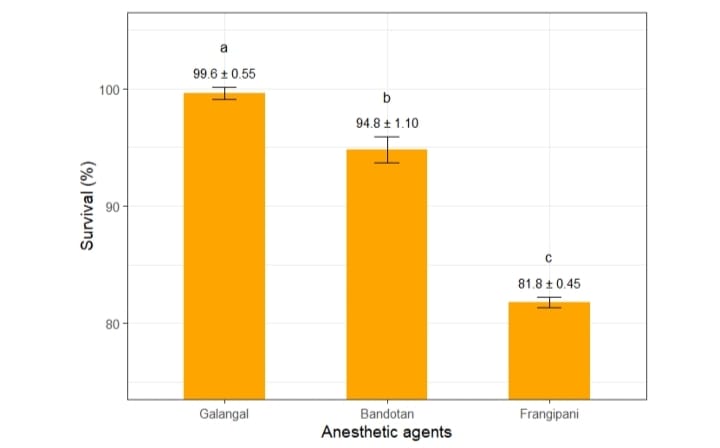
Tilapia (Oreochromis niloticus) is a highly valuable aquaculture species, yet handling and transportation processes often induce stress that can reduce survival. Anesthetics are commonly used to minimize stress, but synthetic agents may leave residues and potentially harm both fish and consumers. Therefore, natural plant-based anesthetics are increasingly explored as safer alternatives. This study aimed to evaluate the effectiveness of galangal (Alpinia galanga), bandotan (Ageratum conyzoides), and frangipani flower (Plumeria acuminata) extracts as natural anesthetic agents for tilapia fry during transport. The experiment used a completely randomized design with three treatments and five replications. Tilapia fry (3–5 cm) were exposed for six hours to plant extracts at predetermined doses. Measured parameters included induction time, recovery time, and survival rate. Data were analyzed using ANOVA followed by Tukey’s test. The results indicated significant differences among treatments. Galangal extract produced the fastest induction (3.9 minutes), quickest recovery (5.5 minutes), and highest survival rate (99.6%). Bandotan extract showed moderate performance, while frangipani flower extract produced the slowest induction, longest recovery, and lowest survival (82%). Overall, galangal extract proved to be the most effective and safest natural anesthetic. The study demonstrates that plant-based anesthetics can reduce transport-related stress without leaving harmful residues, offering practical benefits for sustainable aquaculture, especially in wet transport systems.
Downloads
References
Adewale, A. Y., Adeshina, I., & Yusuf, O. Y. (2017). Anaesthetic effect of Ocimum gratissimum extract on Oreochromis niloticus juveniles. European Journal of Experimental Biology, 7(27), 1-4. https://doi.org/10.21767/2248-9215.100007
Aini, M., Ali, M., & Putri, B. (2014). Penerapan teknik imotilisasi benih ikan nila (Oreochromis niloticus) menggunakan ekstrak daun bandotan (Ageratum conyzoides) pada transportasi basah. E-Jurnal Rekayasa dan Teknologi Budidaya Perairan, 2(2), 217-226.
Callier, S., Snapyan, M., Crom, S.L., Prou, D., Vincent, J., & Vernier, P. (2003). Evolution and cell biology of dopamine receptors in vertebrates. Biology of the Cell, 95, 489-205. DOI: 10.1016/s0248-4900(03)00089-3
Eske, K. A., Jung, S. N., & Fortune, E. S. (2023). The effect of eugenol anesthesia on the electric organ discharge of the weakly electric fish Apteronotus leptorhynchus. Journal of Comparative Physiology A, 209, 625–637. https://pubmed.ncbi.nlm.nih.gov/37999822/
Hasan, U. (2018). Efektivitas berbagai bahan pengisi kemasan pada transportasi ikan sistem kering terhadap kelulusan hidup ikan nila (Oreochromis niloticus). Jurnal Warta, 58, 1-18. DOI: https://doi.org/10.46576/wdw.v0i58.384
Hohlenwerger, J. C., Baldisserotto, B., Couto, R. D., Heinzmann, B.M., da Silva, D. T., Caron, B. O., Schmidt, D., & Copatti, C. E. (2017). Essential oil of Lippia alba in the transport of Nile tilapia. Ciencia Rural, Santa Maria, 47(3), 1-4. DOI: 10.1590/0103-8478cr20160040
Kheafwu, K., Surachai P., Petrine W., Louise von G. J., Thomas R., Anette Mu., Siriporn O (2022). Elucidating pathway and anesthetic mechanism of clove oil nanoformulations in fish. Aquaculture, 554, 738192. https://pubmed.ncbi.nlm.nih.gov/35631505/
Ilhami, R., Ali, M., & Putri, B. (2015). Transportasi basah benih nila (Oreochromis niloticus) menggunakan ekstrak bunga kamboja (Plumeria acuminata). E-Jurnal Rekayasa dan Teknologi Budidaya Perairan, 3(2), 389-396.
Imjai, P., Srisakultiew, P., Rujinanont, N., & Kaewborisut, S. 2018. Anaesthetic effects of Piper betle extracts on nile tilapia Oreochromis niloticus. Prawarun Agricultural Journal, 15(2), 297-304.
Zeng, X., Zheng X., Wu, J., Dong, H., Zhang J. (2024). Assessment of the molecular mechanism in fish using eugenol as anesthesia based on network pharmacology. Scientific Reports, 14, 16321. DOI: 10.1007/s10695-024-01382-x
Midihatama, A., Subandiyono, & Haditomo, A. H. (2018). Pengaruh eugenol terhadap kadar glukosa darah dan kelulushidupan benih gurami selama dan setelah transportasi sistem tertutup. Jurnal Sains Akuakultur Tropis, 2(1), 16–27. https://ejournal2.undip.ac.id/index.php/sat/article/view/2705
Molina-López, A. M., Lora-Benítez, A. J., & Moyano-Salvago, R. (2024). Evaluation of the effectiveness of eugenol and MS-222 as anesthetics in zebrafish in repeated exposures and post-anesthesia behaviour. Animals, 14(16), 2418. https://www.mdpi.com/2076-2615/14/16/2418
Netto, J. D. L., Oliviera, R. S. M., & Copatti, C.E. (2017). Efficiency of essential oils of Ocimum basilicum and Cymbopogum flexuosus in the sedation and anaesthesia of Nile tilapia juveniles. Annals of the Brazilian Academy of Sciences, 89(4), 2971-2974. DOI: 10.1590/0001-3765201720170001
Opiyo, M. A., Ogello, E. C., & Charo-Karisa, H. (2013). Effectiveness of sodium bicarbonate as an anaesthetic for different sizes of nile tilapia (Oreochromis niloticus L., 1758) juveniles. International Journal of Aquatic Science, 4(2), 14-22. https://www.journal-aquaticscience.com/article_73502.html
Pikulkaew, S., Sirimanapong, W., & Pikulkaew, C. (2017). Anesthetic efficacy of eugenol on Nile tilapia (Oreochromis niloticus). Veterinary Medicine International, Article 2537074. DOI: 10.1590/0001-3765201520140024
Rahat, N., Singh, R., & Khan, A. (2020). Use of essential oils as anesthetic agents in aquaculture. Aquaculture International, 28, 1007–1026.
Rezende, F. P., Pascoal, L. M., Vianna, R. A., & Lanna, E. A. T. (2017). Sedation of nile tilapia with essential oils: tea tree, clove, eucalyptus, and mint oils. Revista Caatinga, Mossoro, 30(2), 479-486. https://doi.org/10.1590/1983-21252017v30n223rc
Simoes, L. N., Paiva, G., & Gomes, L. C. (2010). Clove oil as an anesthetic on Nile Tilapia adults. Pesquisa Agropecuaria Brasileira, 45(12), 1472-1477. DOI: https://doi.org/10.1590/S1678-3921.pab2010.v45.9302
Soto, C. G., & Burhanuddin. (1995). Clove oil as a fish anesthetic. Aquaculture, 136, 149–152. https://doi.org/10.1016/0044-8486(95)01051-3
Souza, C. D. F., Baldissera, M. D., Baldisserotto, B., Heinzmann, B. M., Marthos-Sitcha, J. A., & Mancera, M. (2019). Essential oils as stress-reducing agents for fish aquaculture: a review. Frontiers in Physiology, 10(785), 1-17. doi: 10.3389/fphys.2019.00785
Tiexeira, R. R., de Souza, R. C., Senna, A. C., Baldisserotto, B., Heinzmann, B. M., Cuoto, R. D., & Copatti, C. E. (2016). Essential oil of Aloysia triphylla in Nile tilapia: anaesthesia, stress parameters and sensory evaluation of fillets. Aquaculture Research, 48(7), 1-10. https://doi.org/10.1111/are.13165
Ventura, A. S., Filho, R. A. C. C., Teodoro, G. C., Laice, L. M., Barbosa, P. T. L., Stringhetta, G. R., Jeronimo, G. T., & Povh, J. A. (2020). Essential oil of Ocimum basilicum and eugenol as sedatives for Nile tilapia. Journal of Agricultural Studies, 8(2), 657- 665. DOI: 10.5296/jas.v8i2.17075
Yudhistira, C. D. B. S., Pramono, T.B., & Sukardi, P. (2020). Efektivitas infusum daun durian (Durio zibethinus) sebagai anestesi alami ikan lele (Clarias gariepinus). Jurnal Sumberdaya Akuatik Indopasifik, 4,(1), 69-80. https://doi.org/10.46252/jsai-fpik-unipa.2020.Vol.4.No.1.100
Zhou, W., Liang, X., & Li, J. (2021). Natural plant extracts as anesthetics for fish. Aquaculture Reports, 20, 100738.