Antibacterial Activity Test of the Combination of Bay Leaf (Syzygium polyanthum) Extract and Nanochitosan Against Escherichia coli and Bacillus subtilis
DOI:
https://doi.org/10.15294/unnesjlifesci.v14.i1.24777Keywords:
Antibacterial, Bacillus subtilis, Bay leaf, Eschericia coliAbstract
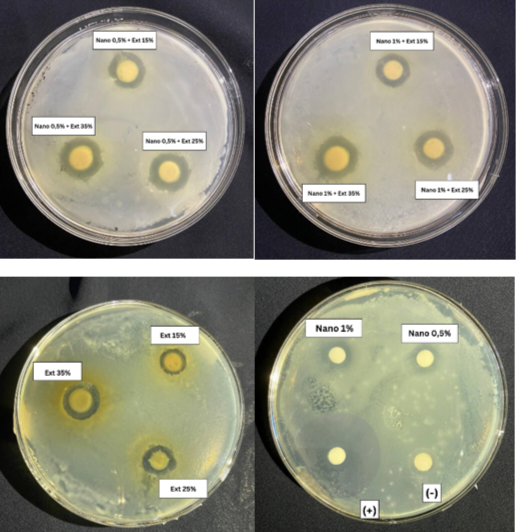
Indonesia is one of the world’s most biodiverse countries, including in medicinal plants that contain active compounds with potential as sources of modern medicine, particularly for treating bacterial infections. The use of herbal plants as antibacterial agents offers an alternative to overcome antibiotic resistance and the side effects of synthetic drugs. Bay leaf (Syzygium polyanthum) and nanochitosan are known for their antibacterial properties due to their bioactive compounds. However, studies on their combined effects are still limited. This study aimed to evaluate the antibacterial effectiveness of combinations of bay leaf extract (15%, 25%, and 35%) and nanochitosan (0.5% and 1%) against Escherichia coli and Bacillus subtilis. A Completely Randomized Design (CRD) was applied, using sterile distilled water as a negative control and 0.1% chloramphenicol as a positive control. The antibacterial activity test was performed using the Kirby-Bauer disk diffusion method. Results showed the positive control produced inhibition zones of 25.45 ± 1.27 mm for E. coli and 25.05 ± 0.39 mm for B. subtilis. The most effective combination was K3 (35% bay leaf extract and 0.5% nanochitosan), which produced inhibition zones of 12.65 ± 0.52 mm and 12.91 ± 0.55 mm, respectively. Statistical analysis using the Tukey HSD post hoc test confirmed significant differences among treatments. These findings suggest that the combination of bay leaf extract and nanochitosan holds promise as an alternative antibacterial agent
Downloads
References
Abobaker, A. M. (2018). Isolation and Identification of Antibacterial and Antispore Compounds from Syzygium Polyanthum L. Leaves. [Thesis. Universiti Putra Malaysia].
Admi, M., Sitorus, A. A., Rinidar, R., Sutriana, A., Rosmaidar, R., & Sugito, S. (2021). The Sensitivity Level of Gentamicine, Cholramphenicol and Penicillin Inhibiting the Growth of Pseudomonas aeruginosa Bacteria Isolate from Aceh Bull Prepunce. Jurnal Medika Veterinaria, 15(1), 1-6. https://doi.org/10.21157/j.med.vet..v14i2.20856
Agustina, N., Hutauruk, T. J. W., Sulistyaningrum, N., Yudhanto, S. M., Liza, N., Kusumaningrum, L., & Setyawan, A. D. (2022). Diversity of the Medicinal Plant in Homegarden of Local Communities in the Coastal Area of Prigi Bay, Trenggalek, East Java, Indonesia. Biodiversitas Journal of Biological Diversity, 23(12), 6302-6312. https://doi.org/10.13057/biodiv/d231226
Dinos, G. P., Athanassopoulos, C. M., Missiri, D. A., Giannopoulou, P. C., Vlachogiannis, I. A., Papadopoulos, G. E., & Kalpaxis, D. L. (2016). Chloramphenicol Derivatives as Antibacterial and Anticancer Agents: Historic Problems and Current Solutions. Antibiotics, 5(2), 20. https://doi.org/10.3390/antibiotics5020020
Egra, S., Mardhiana, M., Rofin, M., Adiwena, M., Jannah, N., Kuspradini, H., & Mitsunaga, T. (2019). Aktivitas Antimikroba Ekstrak Bakau (Rhizophora mucronata) dalam Menghambat Pertumbuhan Ralstonia solanacearum Penyebab Penyakit Layu. Agrovigor: Jurnal Agroekoteknologi, 12(1), 26-31. https://doi.org/10.21107/agrovigor.v12i1.5143
Giannopoulou, P. C., Missiri, D. A., Kournoutou, G. G., Sazakli, E., Papadopoulos, G. E., Papaioannou, D., & Kalpaxis, D. L. (2019). New Chloramphenicol Derivatives from the Viewpoint of Anticancer and Antimicrobial activity. Antibiotics, 8(1), 9. https://doi.org/10.3390/antibiotics8010009
Herlinawati, H. (2020). Efektivitas Ekstrak Daun Buni (Antidesma bunius L) terhadap Pertumbuhan Bakteri Salmonella typhii. Jurnal Kedokteran, 6(1), 49-56. http://dx.doi.org/10.36679/kedokteran.v6i1.308
Iber, B. T., Kasan, N. A., Torsabo, D., & Omuwa, J. W. (2022). A Review of Various Sources of Chitin and Chitosan in Nature. Journal of Renewable Materials, 10(4), 1097. https://doi.org/10.32604/jrm.2022.018142
Isnawati, A. P., Retnaningsih, A., & Nofita, N. (2018). Perbandingan Teknik Ekstraksi Maserasi dengan Infusa pada Pengujian Aktivitas Daya Hambat Daun Sirih Hijau (Piper betle L.) terhadap Escherichia coli. Jurnal Farmasi Malahayati, 1(1), 19-24.
Khairunnisa, S., Tandra, T. A., Sim, M., & Florenly, F. (2020). Efektivitas Antibakteri Campuran Nanokitosan 1% dengan Berbagai Konsentrasi Ekstrak Biji Kelengkeng terhadap Staphylococcus aureus. Jurnal Ilmiah Kesehatan Sandi Husada, 9(1), 430-440. https://doi.org/10.35816/jiskh.v11i1.319
Kassem, A., Ayoub, G. M., & Malaeb, L. (2019). Antibacterial Activity of Chitosan Nano-composites and Carbon Nanotubes: A review. Science of the total environment, 668, 566-576. https://doi.org/10.1016/j.scitotenv.2019.02.446
Kusuma, M. S., Susilorini, T. E., & Surjowardojo, P. (2012). Pengaruh Lama dan Suhu Penyimpanan Ekstrak Daun Sirih Hijau (Piper betle linn) dengan Aquades terhadap Daya Hambat Bakteri Straisyeptococcus agalactiae Penyebab Mastitis pada Sapi Perah. TERNAK TROPIKA Journal of Tropical Animal Production, 18(2), 14-21. https://doi.org/10.21776/ub.jtapro.2017.018.02.3
Magani, A. K., Tallei, T. E., & Kolondam, B. J. (2020). Uji Antibakteri Nanopartikel Kitosan terhadap Pertumbuhan Bakteri Staphylococcus aureus dan Escherichia coli. Jurnal Bios Logos, 10(1), 7-12. https://doi.org/10.35799/jbl.10.1.2020.27978
Malanovic, N., & Lohner, K. (2016). Gram-positive Bacterial Cell Envelopes: The Impact on theActivity of Antimicrobial Peptides. Biochimica et Biophysica Acta (BBA)-Biomembranes, 1858(5), 936-946. https://doi.org/10.1016/j.bbamem.2015.11.004
Munira, M. M., Rasidah, R. R., Melani, E. M., & Nasir, M. N. (2018). Uji Aktivitas Antibakteri Ekstrak Etanol Daun Ketapang (Terminalia catappa L.) Warna Hijau dan Warna Merah serta Kombinasinya. Indonesian Journal of Pharmacy and Natural Product, 1(2), 9-13. https://doi.org/10.35473/ijpnp.v1i2.92
Natheer, S. E., Sekar, C., Amutharaj, P., Rahman, M. S. A., & Khan, K. F. (2012). Evaluation of Antibacterial Activity of Morinda citrifolia, Vitex trifolia and Chromolaena odorata. African journal of pharmacy and pharmacology, 6(11), 783-788. https://doi.org/10.5897/AJPP11.435
Pathak, B. K., Mondal, S., & Barat, C. (2017). Inhibition of Escherichia coli Ribosome Subunit Dissociation by Chloramphenicol and Blasticidin: a New Mode of Action of the Antibiotics. Letters in Applied Microbiology, 64(1), 79-85. https://doi.org/10.1111/lam.12686
Petersen, E. J., Nguyen, A., Brown, J., Elliott, J. T., Clippinger, A. J., Gordon, J., & Roesslein, M. (2021). Characteristics to Consider when Selecting a Positive Control Material for an In vitro Assay. ALTEX-Alternatives to animal experimentation, 38(2), 365-376. https://doi.org/10.14573/altex.2102111
Putri, N. I., Mardianingrum, R., & Susanti. (2023). Formulasi Dan Uji Aktivitas Antijamur Sabun Cair Kewanitaan Ekstrak Etanol Daun Ketepeng Cina (Cassia Alata L.) terhadap Candida albicans. Jurnal Penelitian Farmasi Inonesia, 12(2), 94–103. https://doi.org/10.51887/jpfi.v12i2.1843
Putri, N. O., Rizqiawan, A., Leginis, S. N., Tandean, J. N., Muharram, A., Rahman, M. Z., & Humidat, A. K. (2023). Antimicrobial Susceptibility Test of α-Mangostin Against Peptostreptococcus Bacteria. World, 14(11), 930. https://doi.org/10.5005/jp-journals-10015-2324
Ramadhania, N. R., Purnomo, A. S., & Fatmawati, S. (2018). Antibacterial Activities of Syzygium polyanthum Wight Leaves. AIP Conference Proceedings, 2049(1). https://doi.org/10.1063/1.5082429
Rizeq, B. R., Younes, N. N., Rasool, K., & Nasrallah, G. K. (2019). Synthesis, Bioapplications, and Toxicity Evaluation of Chitosan-based Nanoparticles. International journal of molecular sciences, 20(22), 5776. https://doi.org/10.3390/ijms20225776
Sapoetri, G. I., Revina, R., & Muti, A. F. (2022). Antibacterial Activity Test of Bay Leaf Extracts (Syzygium Polyanthum (Wight) Walp.) Against Staphylococcus Aureus and Escherichia Coli: Systematic Literature Review. Journal of Research in Pharmacy and Pharmaceutical Sciences, 1(1), 36-42. https://doi.org/10.33533/jrpps.v1i1.4460
Shukla, R., Jain, N., Rai, G., Pandey, V., Mourya, P., & Pal, B. (2023). Unlocking the Potential of Bay Leaf: Exploring its Role as a Nutraceutical Carrier through Ethnomedicinal and Pharmacological Insights Drug Pharm. Sci. Arch, 3, 13-23. https://doi.org/10.47587/DPSA.2023.3103
Siagian, Z. A., & Sim, M. (2021). Uji Potensial Antibakteri Ekstrak Daun Salam (Syzygium polyanthum)-Kitosan Nanopartikel 1% terhadap Pertumbuhan Bakteri Staphylococcus aureus. Jurnal Material Kedokteran Gigi, 9(2), 47-56. https://doi.org/10.32793/jmkg.v9i2.470
Supriningrum, R., Fatimah, N., & Wahyuni, S. N. (2018). Penetapan Kadar Flavonoid Ekstrak Etanol Daun Pacar Kuku (Lawsonia Inermis L.) Berdasarkan Perbedaan Cara Pengeringan. Jurnal Ilmiah Manuntung, 4(3), 156–161. https://doi.org/10.51352/jim.v4i2.195
Stan, D., Enciu, A. M., Mateescu, A. L., Ion, A. C., Brezeanu, A. C., Stan, D., & Tanase, C. (2021). Natural Compounds with Antimicrobial and Antiviral Effect and Nanocarriers Used for their Transportation. Frontiers in pharmacology, 12, 723233. https://doi.org/10.3389/fphar.2021.723233
Tammi, A., Apriliana, E., Umiana Sholeha, T., & Ramadhian, D. M. R. (2018). Inhibition Potential of Bay Leaf Extract (Syzygium polyanthum [Wight.] Walp.) as Antibacterial to Staphylococcus aureus In Vitro. Agromedicine Unila, 5(2), 562-566.
Tušek, A. J., Benković, M., Valinger, D., Jurina, T., Belščak-Cvitanović, A., & Kljusurić, J. G. (2018). Optimizing Bioactive Compounds Extraction from Different Medicinal Plants and Prediction through Nonlinear and Linear Models. Industrial Crops and Products, 126, 449-458. https://doi.org/10.1016/j.indcrop.2018.10.04