





Homepage Image

About the Journal

CHI’E: JURNAL PENDIDIKAN BAHASA JEPANG, (E-ISSN: 2685-6662, P-ISSN:2252-6250) starting in 2024 migrates from OJS 2 to OJS 3 to better secure from various unwanted things, including journal hacking and so on. To submit, the author please visit the new website page of our journal at the link https://journal.unnes.ac.id/journals/chie

MIGRATION OFFICIAL STATEMENT HERE

CHI’E: JURNAL PENDIDIKAN BAHASA JEPANG, (E-ISSN: 2685-6662, P-ISSN:2252-6250) is an Open Access, Peer-reviewed, has the perspectives of japanese languages, literature and language teachings. This journal has the Focus and Scope of presenting and discussing some outstanding contemporary issues dealing with Japanese Language Teaching, Japanese Literature & Japanese Linguistics.
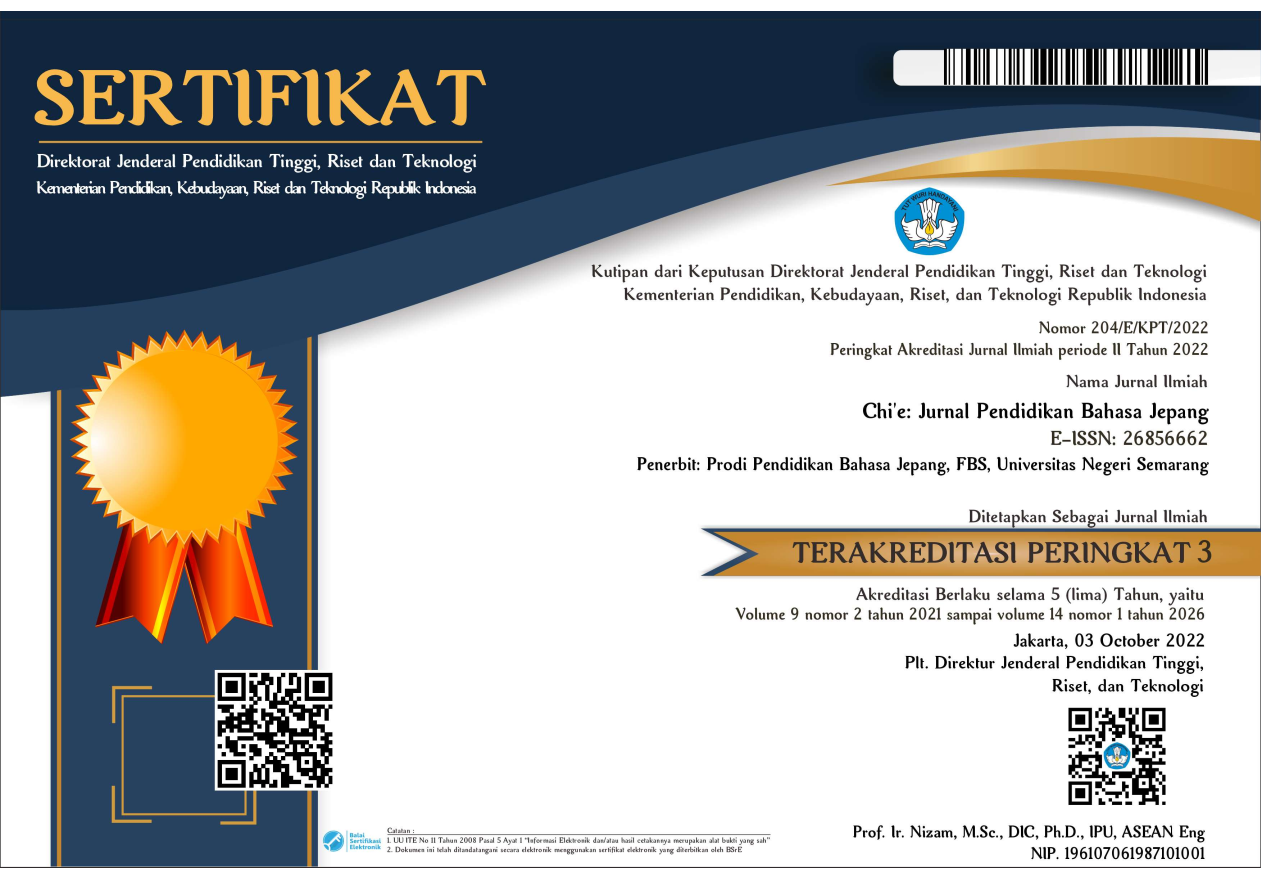
This journal is published every March and October by Prodi Pendidikan Bahasa Jepang, Universitas Negeri Semarang, Indonesia, and accredited by the Indonesian Ministry of Research, Technology and Higher Education (RistekDikti) of the Republic of Indonesia in SINTA (Achieving Sinta 3) since Volume 9 (2) 2021 Until Volume 14 (1) 2026. The recognition was published in Director Decree (SK No. 204/E/KPT/2022).

Current Issue

Vol. 13 No. 2 (2025): October 2025

This issue has been available online since 31th October 2025. All articles in this issue (10 original research articles) were authored/co-authors from 1 countries (Indonesia).

Published: 2025-10-31

Articles

  • Linguistic Features and Conversational Functions of the Tosa Dialect in Gintama

    Julia Julia, Rani Arfianty (Author)
    81-89
    Article ID 18220
    DOI: https://doi.org/10.15294/chie.v13i2.18220
  • Exploring Students’ Perceptions of the Summary Method as a Reading Comprehension Strategy in Japanese Language Learning

    Nur Mustika Indah Permatasari, Febi Ariani Saragih (Author)
    90-97
    Article ID 23409
    DOI: https://doi.org/10.15294/chie.v13i2.23409
  • Criminality and Social Structure in Takeshi Kitano’s Outrage: A Sociological Approach

    Ayu putri Seruni, Muhammad Filzarifadly (Author)
    98-107
    Article ID 24595
    DOI: https://doi.org/10.15294/chie.v13i2.24595
  • Evaluating the Effect of Digital Media and Coginitive Styles on Kanji Learning: An Experimental Study Using Tanoshiijapanese.com

    Nia Setiawati, Muhamad Aldillah, Cut Erra Rismorlita (Author)
    108-121
    Article ID 31041
    DOI: https://doi.org/10.15294/chie.v13i2.31041
  • Paralinguistic Features in Cross-Cultural Communication: A Study of Indonesian-Japanese Married Couples in Vlogs

    Wina Widia Hastuti, Susi Widianti (Author)
    122-130
    Article ID 29082
    DOI: https://doi.org/10.15294/chie.v13i2.29082
  • Understanding Reading Themes and Question Types in JLPT N5: Insight from Practice Books

    OPI SUKARDI PUTRI, Novia Hayati, Juju Juangsih (Author)
    131-140
    Article ID 29330
    DOI: https://doi.org/10.15294/chie.v13i2.29330
  • Patriarchy and the Regulation of Feminity in Edo Japan: A Foucauldian Discourse Analysis

    Nina Alia Ariefa (Author)
    141-147
    Article ID 31439
    DOI: https://doi.org/10.15294/chie.v13i2.31439
  • The Representation of Magical Realism Elements in the Novel Sputnik Sweetheart by Haruki Murakami

    Dian Annisa Nur Ridha, Muhamad Ramadhan (Author)
    148-158
    Article ID 31539
    DOI: https://doi.org/10.15294/chie.v13i2.31539
  • Morphopragmatic Features of Japanese Diminutives: A Literature Review

    Kadek Eva Krishna Adnyani, Putu Dewi Merlyna Yuda Pramesti, Gede Satya Hermawan (Author)
    159-165
    Article ID 25039
    DOI: https://doi.org/10.15294/chie.v13i2.25039
  • Internal and External Factors Influencing Kanji Learning among Japanese language Students in Indonesia

    Diah Ayu Fani, Hari Setiawan, Kun Makhsusy Permatasari (Author)
    166-177
    Article ID 32002
    DOI: https://doi.org/10.15294/chie.v13i2.32002
View All Issues